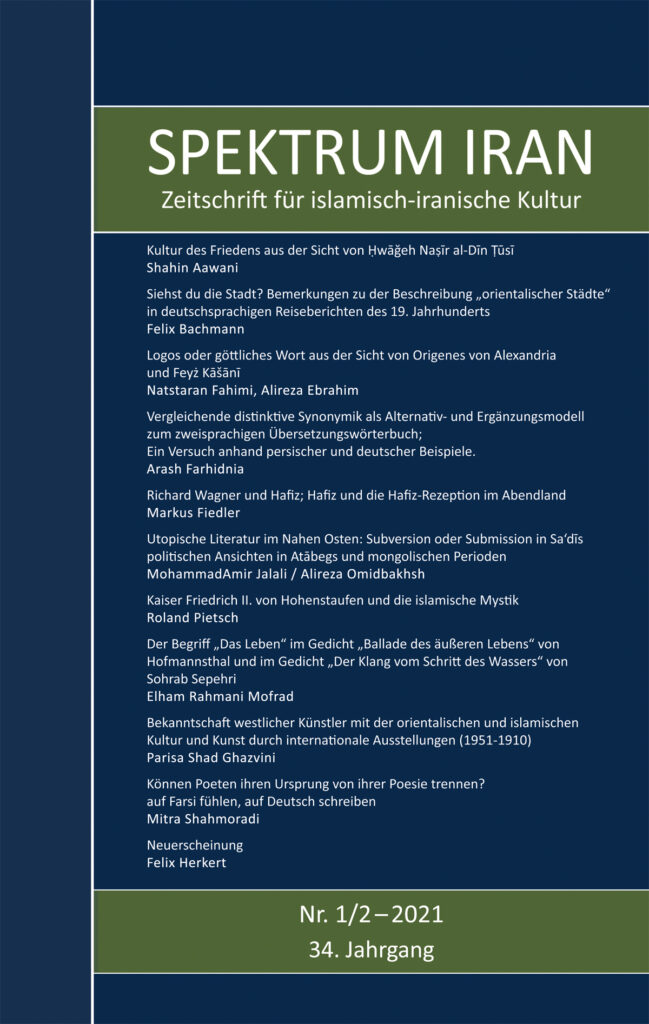
Das Interesse am persischen Dichter und Mystiker Ḥāfeẓ (1315–1390) nahm im Westen ab dem 18. Jahrhundert zu, insbesondere durch die Übersetzungen von Sir William Jones (1746–1794) in England. Die deutsche Übersetzung von Baron von Hammer-Purgstall inspirierte Goethe im 19. Jahrhundert zur Abfassung des West-östlichen Divans (veröffentlicht 1819). Die Dichtung von Ḥāfeẓ begeisterte Goethe so sehr, dass er ihn als „heiligen Ḥāfeẓ“ und „himmlischen Freund“ bezeichnete. Angeregt durch Goethes West-östlichen Divan verfassten mehrere deutsche Dichter – darunter Rückert und Graf Platen – Gedichte nach dem Vorbild der Ghazal-Form, die Ḥāfeẓ in der persischen Literatur zur Vollendung gebracht hatte. Auch Friedrich Nietzsche, Wagners Freund und späterer Gegner, zählt zu den deutschen Denkern, die von Ḥāfeẓ beeinflusst und fasziniert waren. Nach der Untersuchung dieser historischen Belege zeigt der Beitrag, inwiefern Richard Wagner von Form und Inhalt der Dichtung Ḥāfeẓs profitiert hat.
Fiedler, Markus. (2021). Richard Wagner und Hafiz; Hafiz und die Hafiz-Rezeption im Abendland. Spektrum Iran, 34(1), 77–84. https://doi.org/10.22034/spektrum.2021.184661
MLA
Fiedler, Markus. "Richard Wagner und Hafiz; Hafiz und die Hafiz-Rezeption im Abendland", Spektrum Iran, 34, 1, 2021, 77–84. doi: 10.22034/spektrum.2021.184661
HARVARD
Fiedler, Markus. (2021). 'Richard Wagner und Hafiz; Hafiz und die Hafiz-Rezeption im Abendland', Spektrum Iran, 34(1), pp. 77–84. doi: 10.22034/spektrum.2021.184661
CHICAGO
Fiedler, Markus, "Richard Wagner und Hafiz; Hafiz und die Hafiz-Rezeption im Abendland." Spektrum Iran, 34 1 (2021): 77–84, doi: 10.22034/spektrum.2021.184661
VANCOUVER
Fiedler Markus. Richard Wagner und Hafiz; Hafiz und die Hafiz-Rezeption im Abendland. Spektrum Iran. 2021;34(1):77–84. doi: 10.22034/spektrum.2021.184661